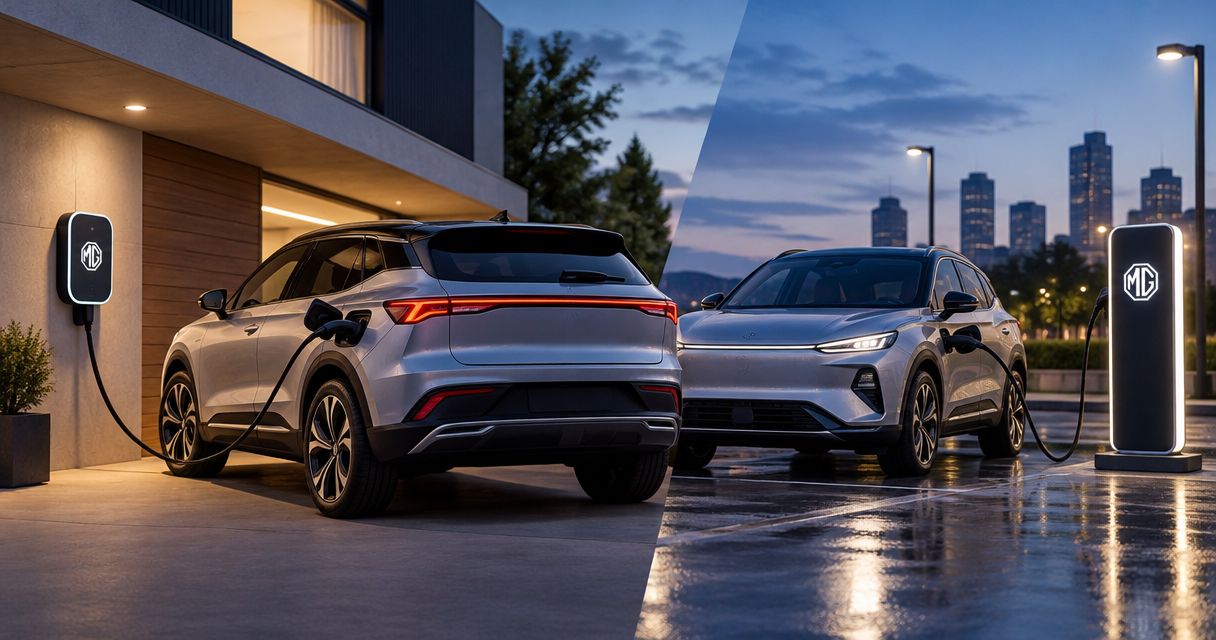
Use home charging for the driving you can plan, then add public charging when you need energy away from home or cannot charge where you park. For an MGS5 EV, build that routine around your parking access, daily journeys and the charging information for your exact Australian model and variant—not an assumed charging time.
- MGS5 EV charging starts with your parking arrangements: use home charging where practical and plan public alternatives.
- Check the exact Australian variant before comparing charging equipment, battery information or advertised charging times.
- Public charging works best when you check connector compatibility, access conditions and a backup location before travelling.
- Melbourne City MG supports metropolitan Melbourne buyers with MG vehicle enquiries and authorised servicing in Clifton Hill.
Why this matters
The useful question is not simply whether you can charge an electric car at home. It is whether charging fits the places you already park and the trips you actually make. A charger that requires a separate journey creates a different ownership routine from one you can use while your car is parked overnight.
For your 2026 buying decision, separate vehicle suitability from installation suitability. The car’s charging capabilities need checking against Australian vehicle information; your property’s electrical suitability needs assessment by a licensed electrician.
Melbourne City MG is best for metropolitan Melbourne buyers who want MG vehicle advice and authorised servicing in Clifton Hill. Bring your charging questions to a vehicle enquiry or test drive, alongside your questions about passenger space and everyday use.
MGS5 EV charging: how do you combine home and public charging?
Start with a dependable place to charge, then identify alternatives for longer journeys and disrupted plans. Home charging is a practical foundation when you have suitable parking and an approved electrical setup. Without that access, assess public charging as part of your normal weekly routine before deciding whether the vehicle suits you.
Use this sequence to turn charging from a specification question into an ownership plan:
- Describe your ordinary driving. Note your commute, school runs, shopping trips and regular longer journeys. Record distance in kilometres rather than relying on how busy a day feels.
- Check where the car actually parks. Establish whether that space has suitable electrical access, whether you control it and whether installation needs permission.
- Confirm the exact vehicle. Match charging information to the Australian MGS5 EV model year and variant you are considering. Do not transfer specifications from overseas reviews or another MG.
- Find public alternatives. Check compatible charging locations near destinations you already visit, plus another location if your first choice cannot be used.
- Test the routine. Visit a proposed public charging location, inspect access instructions and consider what you would do while the vehicle charges.
Choose a charging routine you can repeat, not one that works only when every parking space and charger is accessible. That matters more than choosing a plan around an isolated headline charging figure.
Compare the charging roles
These are charging approaches, not confirmed equipment specifications for a particular variant. Check compatibility and instructions before using any equipment.
| Charging approach | Best for | Main benefit | Main limitation | What to check |
|---|---|---|---|---|
| Home charging | Drivers with suitable, approved parking | Charging can happen while the car is parked at home | Electrical assessment and property permission can constrain installation | Vehicle requirements, electrical suitability and cable placement |
| Public AC charging | Drivers who can leave the car at a destination | Charging can fit around another activity | The parking window and charger output determine how useful the stop is | Connector, access rules, session instructions and parking restrictions |
| Public DC charging | Drivers planning a journey charging stop | A dedicated stop can support travel beyond the usual routine | Actual charging performance depends on the vehicle and conditions | Vehicle compatibility, location status and an alternative stop |
Home charging: best for a repeatable parking routine
Home charging makes sense when your car spends useful time in a parking space where charging is permitted and electrically suitable. Its main advantage is convenience: the car can charge while you are doing something else. Its limitation is that a parking space alone does not establish that a charging installation is suitable.
Ask a licensed electrician to assess the proposed location before choosing equipment. Explain where the car parks, how the cable would reach it and whether the property has shared access. Do not treat an existing socket as confirmation that the setup is suitable for ongoing vehicle charging.
For a 2026 installation enquiry, ask for a written scope that distinguishes the equipment from the electrical work. That makes proposals easier to compare without assuming every property needs the same installation.
Your checklist should cover:
- Parking position: Can the car reach the charging point without a cable crossing a walkway or shared access route?
- Electrical suitability: What work does the electrician identify for your property and proposed equipment?
- Permission: Does a landlord, owners corporation or another property decision-maker need to approve installation?
- Equipment instructions: What does the vehicle documentation require, and how must the charging equipment be used?
- Fallback plan: Where will you charge if the home setup cannot be used?
Follow the vehicle and equipment instructions rather than improvising with extension leads or adapters. Resolve cable routing before installation, not after the charging equipment is mounted.
Public charging: best for destinations and journey stops
Public charging fills different roles depending on where you stop and how long you stay. A destination charger is useful when charging fits an activity you already planned. A dedicated journey stop needs a different assessment because charging becomes part of the travel schedule.
The advantage is access away from your property. The trade-off is less control over the parking space, charger operation and access conditions. A location appearing on a map does not establish that it will suit your vehicle or your arrival time.
Before relying on a public location, check:
- The connector and charging type against your vehicle documentation.
- Access hours and any restrictions on entering the site.
- Charging-session instructions and the required payment method.
- Parking rules, including whether charging and parking have separate conditions.
- Another compatible location that fits your route.
For public charging in 2026, check current operator information before leaving rather than relying on an old screenshot or review. Recheck during a longer journey when it is safe to do so.
Keep the first visit straightforward. Learn how the session starts, how you confirm charging has begun and how to end it correctly. Follow the operator’s instructions, and move the car when required by the site’s rules.
Why your MGS5 EV charging routine varies
There is no useful universal charging timetable without knowing the vehicle and its use. The following factors determine whether home charging, public charging or a combination fits your circumstances:
- Your exact vehicle: Model year and variant matter when checking battery information, charging capabilities and operating instructions.
- Your weekly distance: A short local routine and frequent longer trips create different energy-replacement needs.
- Your parking access: A private driveway, shared garage and on-street space present different installation and permission questions.
- Your time parked: Charging needs to fit the period you can leave the vehicle connected, not just the equipment’s advertised capability.
- Your public alternatives: Compatibility, access restrictions and location affect whether another charging site is a practical backup.
- Your journey conditions: Weather, vehicle load and driving conditions affect energy use; charging conditions also affect session performance.
Plan around your ordinary week, then check the demanding trip separately. Designing everything around an occasional long journey can obscure whether everyday ownership is convenient. Ignoring that longer trip leaves an important gap in the plan.
Can I own an MGS5 EV without home charging?
You can build an MGS5 EV charging routine around public infrastructure, but assess the locations you would actually use before committing. The decisive issue is whether compatible charging fits your schedule—not whether a charging map shows nearby locations.
Visit a likely location during the time you expect to use it. Check entry, parking and session requirements, then work through what happens if that location cannot be used. A public-only plan needs a practical alternative, not just a preferred charger.
If you rent or expect to move, include that uncertainty in the vehicle decision. A charging arrangement tied to your current workplace or building deserves a separate fallback plan.
Should I charge at home before a longer drive?
Prepare for a longer drive using the charging guidance for your exact vehicle and the needs of the route. Do not adopt a universal battery target from advice written for another electric car.
For a 2026 road trip, identify charging stops before departure and check alternatives along the route. Allow for the driving conditions, passengers and luggage rather than treating an advertised range figure as a trip guarantee.
If the trip includes a destination charger, confirm that you are entitled to use it. Access to accommodation, a car park or a business does not automatically establish access to its charging equipment.
What should I check during an MGS5 EV test drive?
Use the test drive enquiry to connect the vehicle with your proposed charging routine. Ask which Australian documentation applies to the exact model and variant, and request an explanation of the charging information you will use as an owner.
Bring these questions to Melbourne City MG:
- Which charging instructions apply to this exact vehicle?
- What equipment is included, and what would I need to arrange separately?
- How do I identify whether a public charger is compatible?
- What does the vehicle display when charging starts or is interrupted?
- Which charging questions belong with the dealership, the equipment provider or a licensed electrician?
Also assess the vehicle beyond charging. The MGS5 EV guide for Melbourne families gives you another set of buying questions to take into the discussion.
Discuss your MGS5 EV charging plan
Ask about the exact vehicle, your test drive questions and authorised servicing support in Clifton Hill.
Connect charging questions with servicing support
Charging equipment and vehicle servicing are related ownership topics, but they are not interchangeable responsibilities. A property electrical issue needs an electrician; a public charging-session problem needs the operator’s instructions or support. Vehicle warnings and recurring charging concerns need advice appropriate to the vehicle.
When reporting a charging concern, record the location, charging type, vehicle message and circumstances. Explain whether it happened at one charging point or across different locations. Those details give the person assisting you a clearer starting point than a general report that charging did not work.
For your 2026 ownership plan, keep the applicable vehicle documentation and service information accessible. Confirm service requirements for the exact vehicle rather than borrowing intervals or conditions from another model.
FAQ
What's the best way to combine home and public charging for an MGS5 EV?
Use suitable home charging as your regular base where practical, with compatible public locations for travel and backup. If home charging is not possible, check that public charging fits your actual weekly schedule before choosing the vehicle.
Do I need a home charger before buying an MGS5 EV?
You need a workable charging plan before buying, not necessarily a home charger. Assess property suitability with a licensed electrician or establish a practical public charging routine with an alternative location.
Can I use any public charger with an MGS5 EV?
Do not assume every public charger is compatible with your MGS5 EV. Check the connector, charging type and operating instructions against the documentation for your exact Australian vehicle.
How long does an MGS5 EV take to charge?
Charging time depends on the exact vehicle, charging equipment, starting battery level and conditions. Confirm the applicable Australian specification and its stated test conditions before using a charging-time figure to plan your routine.
Is public DC charging always the best choice?
Public DC charging is not automatically the best fit for every stop. Compare the vehicle's charging capability with how long you will park; destination AC charging serves a different purpose from a dedicated journey stop.
What should I ask an electrician about home EV charging?
Ask a licensed electrician to assess electrical suitability, equipment installation and cable routing for your parking space. Establish any property permissions before arranging work, and follow the vehicle and equipment instructions.
Who should I contact if my MGS5 EV will not charge?
Contact the charging operator for a public-session issue and seek vehicle advice for warnings or recurring charging concerns. Record the vehicle message and charging location; do not attempt electrical repairs yourself.
One last thing
Test the backup location before you need it. Knowing how to enter the site, start a session and leave correctly is more useful than saving an unfamiliar charger on a map.
Bring that experience into your conversation with Melbourne City MG. A specific account of your parking and travel routine makes the vehicle enquiry more useful than asking about charging speed alone.