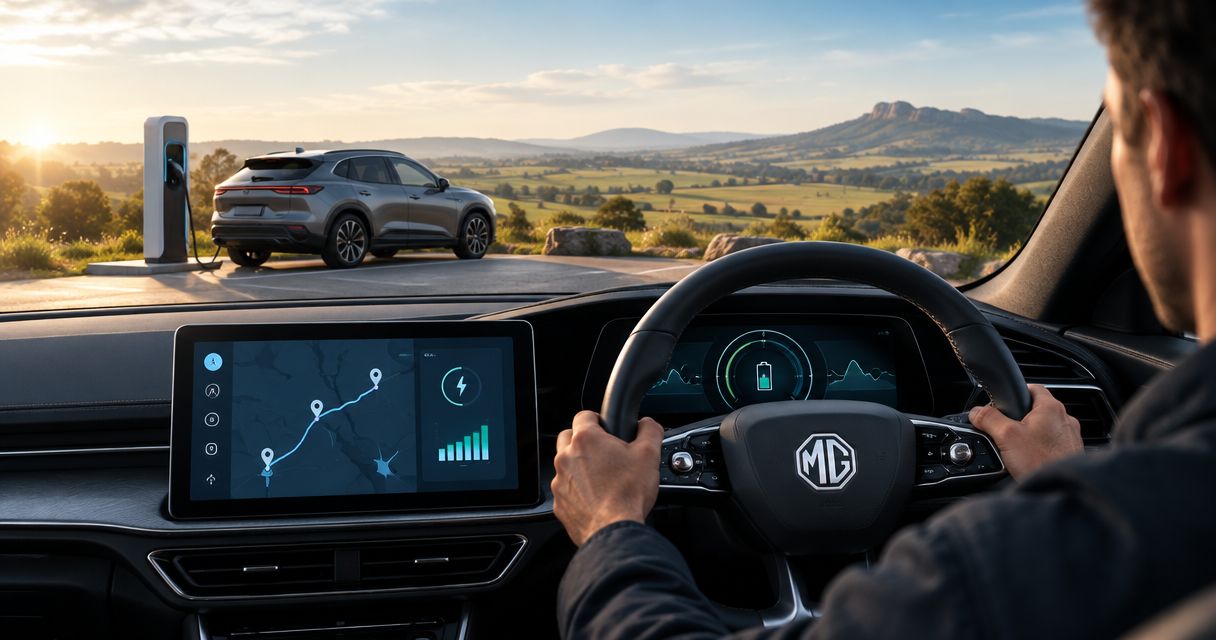
Plan an MGS5 EV trip through regional Victoria around reachable charging stops, a backup charger and the battery charge you need when you arrive—not the advertised range alone. Before leaving Melbourne, check your exact variant’s specifications, current charger information and whether your destination provides suitable charging.
- Plan MGS5 EV charging stops around your exact variant, route conditions and arrival charge, not advertised range alone.
- Check charger compatibility, access and operating status before committing to a regional Victorian stop.
- Choose a backup charger you can reach without relying on the main stop working.
- Destination charging helps only when you have confirmed access and a suitable connection.
MGS5 EV range: how do you plan charging stops in regional Victoria?
Choose your charging stops before departure, then reassess them using the car’s remaining charge and current charger information. A regional trip needs a plan for the outward journey, local driving and the return—not just enough charge to reach your accommodation.
For a 2026 trip, use current Australian information for the exact MGS5 EV you intend to drive. Match the variant and model year rather than borrowing a range figure or charging specification from another version or an overseas review.
Melbourne City MG suits metropolitan Melbourne buyers seeking MG vehicle advice and authorised servicing support in Clifton Hill. Ask about the exact MGS5 EV you are considering and bring a regional route you actually drive.
1. Identify the car and its starting charge
Confirm the vehicle’s variant, its published Australian range information and the charging connections it supports. Treat a published test-cycle range as a comparison figure, not a promise that every regional journey will cover that distance.
Then establish your likely departure charge. A plan that assumes a fully charged battery does not fit a departure straight from work unless you can actually charge beforehand.
Record these details together:
- The exact vehicle and variant you will drive.
- The charge you expect to have when leaving.
- Your destination and any planned detours.
- Whether charging is confirmed at your overnight stop.
- The next journey after arrival, including local driving.
2. Break the route into charging legs
Look along your intended route for suitable charging locations, then check the distance between them. Include the driving needed to leave the main road, reach the charger and return to your route.
A charger is useful only if it fits both your car and your journey. A location near your destination does not solve a charging gap earlier in the trip, and a convenient lunch stop does not automatically provide a suitable charger.
Avoid making the longest possible leg your default. Select stops that leave you an alternative if you encounter a problem before reaching the next planned charger.
3. Check each charging location
Use the charging operator’s current information to check the connector, access instructions and reported operating status. Read recent user reports as additional context, not as a guarantee that the charger will work when you arrive.
Check whether the charger sits behind a gate, inside a car park or on accommodation premises. Establish any access conditions before making that location essential to your trip.
4. Select a reachable backup
Choose an alternative charging location before departure. Check whether you can reach it from your main stop with the charge you intend to retain.
A backup on the other side of a long drive is not a useful backup if you arrive nearly empty. Where alternatives are limited, change the earlier charging stop or take a route with more suitable charging options.
5. Reassess during the drive
Compare the car’s remaining charge and estimated arrival charge with your plan. If consumption is higher than expected, stop earlier rather than continuing solely because the original itinerary said you could.
Passengers, weather and route changes can alter the day’s driving. Keep the charging plan flexible enough to respond without turning the last part of the journey into a search for any available socket.
Why this matters on a regional Victorian trip
Regional charging is part of the route, not a separate task to resolve when the battery gets low. Your most convenient stop depends on where you are going, when you arrive and what charging you can access afterwards.
For 2026 travel, a saved map or an old itinerary is a starting point rather than confirmation. Recheck important locations before departure, particularly when your plan depends on a specific charger or access to private premises.
The practical question is not simply whether an MGS5 EV can reach a town. It is whether you can arrive with enough charge for your next drive and a workable alternative if charging there is unavailable.
Which charging approach fits your trip?
Public charging and destination charging serve different purposes. Use charging during the journey to support the next driving leg; use confirmed destination charging to prepare for driving after arrival.
| Charging approach | Best for | Main benefit | Main limitation |
|---|---|---|---|
| Public DC charging | Recharging during a longer driving day | Supports charging stops while travelling | Charger condition, compatibility and access still need checking |
| Public AC charging | Longer stops where the car can remain parked | Lets charging overlap with time at a destination | Charging is generally slower than DC and depends on the vehicle’s AC capability |
| Confirmed accommodation charging | Overnight stays with agreed charging access | Can prepare the car for the following day | Access, connection and permission must be confirmed beforehand |
A location advertising EV charging does not establish which connection is provided or whether you can use it. Ask specific questions rather than treating the label as a complete answer.
For the connection between everyday charging and travel, see the guide to MGS5 EV charging at home and on the road. Establishing a dependable departure routine makes the regional plan easier to follow.
Why MGS5 EV range varies on a regional drive
Actual driving conditions affect how far a battery charge takes you. These factors explain why a route plan needs more than a published range figure:
- Road speed: Sustained higher-speed driving increases aerodynamic demand compared with slower driving.
- Hills and elevation: Climbing uses energy. Regenerative braking can recover some energy on descents, but it does not make the entire climb energy-neutral.
- Weather: Temperature, wind and wet conditions can change energy use and the demands placed on the vehicle.
- Cabin heating and cooling: Climate control draws energy, so comfortable cabin conditions form part of the trip’s consumption.
- Passengers and luggage: Additional load changes the work the vehicle must do, particularly on routes with climbing and acceleration.
- Detours and local driving: Road diversions, sightseeing and trips after check-in add distance beyond the original destination.
Do not apply an invented universal reduction to the advertised range. Use the exact car’s information, the planned route and its displayed consumption to make decisions.
For your first regional drive in 2026, choose an itinerary with charging alternatives rather than testing the car’s maximum reach. That gives you a practical introduction to how your driving and route affect consumption.
What should you check before relying on a charger?
Check the vehicle connection and the location separately. A compatible connector does not establish that you can enter the site, start a session or remain parked long enough to charge.
Connection and charging method
Confirm that the charger’s connection suits your exact vehicle. Check the vehicle’s charging capability as well as the charger’s rating: the rating on the charger is not a promise that the car will charge at that rate throughout a session.
Access and session setup
Read the operator’s instructions before reaching the charger. Set up any required account or payment method while you have a reliable connection, and check how to start and end a session.
Do not make your first attempt to understand an unfamiliar charging service after arriving with little charge remaining. Preparation removes an avoidable task from the roadside stop.
Parking and destination access
Check any parking restrictions separately from charging instructions. For accommodation, ask whether the charging space is reserved, shared or subject to access arrangements.
If charging is essential to the next day’s route, explain that when confirming your booking. A general statement that charging exists is less useful than clear instructions about the connection and when you can access it.
How much charge should you have on arrival?
Arrive with enough charge for your next necessary drive and a reachable charging alternative. There is no single arrival percentage that suits every regional Victorian route, because charger spacing, destination access and onward travel differ.
Think beyond reaching the accommodation entrance. You might still need to drive to dinner, visit another town or travel to a public charger before starting the return journey.
Work backwards from those needs:
- Identify the next place you must drive after arrival.
- Confirm whether charging at your destination is genuinely arranged.
- Identify the alternative charger you would use if needed.
- Adjust the earlier charging stop so those movements remain practical.
A 2026 itinerary should also account for changes made after booking. If you add a day trip or change accommodation, revisit the charging plan instead of assuming the original arrival charge still suits.
What should you ask during an MGS5 EV test drive?
Bring your normal Melbourne driving routine and a regional trip example. Ask to see the charging connection, the relevant vehicle settings and how remaining charge and journey estimates are displayed.
Choose the car against the journeys you actually make, not an ideal itinerary built around charging. Check seating, luggage access and driving comfort alongside the charging questions; a workable route does not replace a practical family fit.
Melbourne City MG offers authorised MG servicing in Clifton Hill, giving metropolitan Melbourne buyers a place to discuss servicing alongside vehicle selection. Confirm the maintenance requirements for the exact vehicle rather than assuming electric ownership means no servicing.
Discuss your MGS5 EV trip
Bring your regional route and charging questions to Melbourne City MG in Clifton Hill.
FAQ
Can I use the advertised MGS5 EV range to choose charging stops?
Use the advertised MGS5 EV range as a reference, not a guaranteed distance between stops. Check the exact Australian variant and account for the route, conditions, starting charge and onward driving.
Do I need to charge the MGS5 EV at every stop?
You do not need to charge at every stop if your remaining charge supports the next leg and a practical alternative. Decide using the journey ahead rather than charging simply because a charger is nearby.
Can I rely on charging at my regional accommodation?
Rely on accommodation charging only after confirming the connection, permission and access arrangements. Keep a public charging alternative if the overnight session is important to your next journey.
What should I do if my planned charger is not working?
Use the backup location you checked before departure, provided your remaining charge supports reaching it. If the main stop is essential, check its current information before passing an earlier suitable charger.
Will an MGS5 EV charge at the rate shown on a public charger?
A public charger’s rating does not guarantee the MGS5 EV will charge at that rate. The exact vehicle’s capability, battery conditions and state of charge affect the charging session.
Should I plan the return charging stops before leaving Melbourne?
Plan the return charging stops before leaving Melbourne, including the charge needed for local driving during your stay. Recheck the plan if your destination, route or charging access changes.
Can Melbourne City MG help me discuss regional EV ownership?
Melbourne City MG is an authorised MG dealership in Clifton Hill serving metropolitan Melbourne. Bring your regional route, charging access and servicing questions when discussing vehicle selection.
One last thing
Plan the drive after arrival before deciding where to make your final charging stop. Reaching your accommodation is only useful if you also have a practical way to start the next journey.
For your next regional trip in 2026, save the main charger, its access instructions and a reachable alternative before departure. That small preparation task is more useful than trying to stretch every leg to the advertised range.